
Conducting a competitive analysis is essential in understanding your position in the market. Comparing your performance with the market can help you make informed decisions and assess your progress. To start, you need to identify who your competitors are and how to best benchmark your hotel performance. This article will provide you with useful tools to get you started.
Defining the Market Position in the Hotel Industry
Within the travel and hotel industry, a hotel can define the market it is operating in from the guest’s perspective by considering the city, region, or touristic destination. This provides a straightforward method for defining the market in which the hotel operates. It is recommended to examine the full market to get an understanding of the market position. This involves considering all levels of competition, including brand competition, product competition, generic competition, and need competition.
Examples of Competition Categories:
- Brand Competition: The Amsterdam hotel market is highly competitive with a variety of global hotel brands such as NH Hotels, Marriott, Hilton, and Hyatt competing for customers.
- Product Competition: Several hotels in Amsterdam such as Hotel V, Hotel Estherea, Andaz Amsterdam and Hotel Pulitzer offer different star ratings, providing guests a clear indication of the type of hospitality experience they can expect.
- Generic Competition: Hotels, B&Bs, hostels, and Airbnb rentals are all competing for the same pool of customers in Amsterdam.
- Need Competition: Amsterdam hotels have to compete for customers in the luxury, mid-range, and budget categories. Often used categories within the hotel industry are Luxury, Upper Upscale, Upscale, Upper Midscale, Midscale, and Economy.
Understanding Market Performance: MPI, ARI, and RGI
Key performance indicators (KPIs) are crucial for evaluating your hotel’s effectiveness. Three major KPIs in the hotel industry are the Market Penetration Index (MPI), Average Rate Index (ARI), and Revenue Generation Index (RGI).
Market Penetration Index (MPI)
MPI helps you gauge your market share in comparison to your competitors. It’s calculated as follows:

- Example: If your hotel has an occupancy rate of 70% while the market occupancy rate is 60%, your MPI would be (70/60)×100=116.67(70/60)×100=116.67. An MPI greater than 100 indicates market outperformance.
Average Rate Index (ARI)
ARI shows how your hotel’s average daily rate (ADR) compares to the market average:

- Example: If your ADR is €150 and the market ADR is €130, your ARI would be (150/130)×100=115.38(150/130)×100=115.38. An ARI above 100 suggests you’re charging more than the market average.
Revenue Generation Index (RGI)
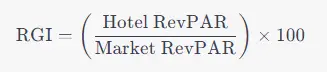
RGI combines occupancy and rate to provide a comprehensive view of your revenue performance:
- Example: If your ADR is €150 and the market ADR is €130, your ARI would be (150/130)×100=115.38(150/130)×100=115.38. An ARI above 100 suggests you’re charging more than the market average.
While MPI (Market Penetration Index) focuses on understanding the demand for your hotel in relation to the overall market demand, ARI (Average Rate Index) zeroes in on your pricing strategies compared to your competitors. Together, these metrics allow you to gauge both your market reach and the competitiveness of your pricing.
RGI (Revenue Generation Index) brings these two critical elements together, offering a composite, well-rounded view of your overall revenue performance. It synthesizes how well you’re capturing the market (MPI) and how effectively you’re pricing your rooms (ARI) to give you a holistic understanding of your revenue prowess in the competitive landscape.
What makes these KPIs truly actionable is their capacity for temporal analysis. By tracking these metrics over time, a hotel can identify specific areas and moments of underperformance. Variations in sesonallity, type of days and segments can be tracked.
Introducing Guest Rate Index (GRI) and Net Promoter Score (NPS)
While MPI, ARI, and RGI are invaluable financial indicators that help in shaping your pricing and market penetration strategies, they present only half of the full picture. To truly outperform the competition, a hotel needs to equally focus on guest satisfaction metrics.
Once specific performance patterns are identified through financial KPIs, targeted strategies can be created to bolster underperforming areas. For instance, if a hotel lags in weekday bookings, introducing business-friendly amenities and corporate packages could be the solution. But how do you ensure that these changes resonate well with your clientele?
That’s where guest satisfaction metrics come into play. By integrating guest satisfaction metrics into your analytical framework, you can understand the impact of the changes you implement. These guest-centric metrics provide evidence-based insights that empower a hotel to refine its services and amenities.
What is Guest Rate Index (GRI)?
The Guest Rate Index (GRI) is a calculated metric that quantifies your hotel’s guest review ratings in relation to your competitors. It’s designed to give you an at-a-glance understanding of how well you are doing in terms of guest satisfaction, relative to the competition.

How to Use GRI
Understand the Gap: A GRI score less than 100 indicates that your guest reviews are lagging behind those of your competitors. For example, if your competitors average a 9.2 in guest reviews and you are at 8.8, your GRI would be 95.65. while thinking an 8.8 is a good job, in your specific market you are still underpeforming.
Identify Strengths and Weaknesses: GRI can be broken down into sub-categories such as room quality, staff friendliness, and amenities to provide a more detailed analysis.
Strategic Planning: Use the GRI to inform your hotel’s strategy. If you are lagging in certain areas, focus your improvements there.
Net Promoter Score (NPS)
NPS is a key metric that measures customer loyalty by asking a simple question: “On a scale of 0-10, how likely are you to recommend our hotel to a friend or colleague?” Those who respond with a score of 9 to 10 are considered ‘Promoters.’ Those who respond with a score of 0 to 6 are ‘Detractors.’ The NPS is calculated by subtracting the percentage of Detractors from the percentage of Promoters.

How to Use NPS
-
Customer Loyalty: A high NPS score generally indicates strong customer loyalty and satisfaction, which can be a strong competitive advantage.
-
Strategic Insights: Low NPS can be a red flag and warrants immediate attention to service quality and guest experience.
-
Comparison Benchmark: Your NPS can be compared with industry standards or competitors’ scores to assess your market position.
Comprehensive Competitiveness: A Holistic View
By integrating traditional financial KPIs with guest satisfaction metrics, you gain a holistic understanding of your competitive position. This comprehensive approach allows you to craft a data-backed strategy aimed at achieving a distinct edge in the marketplace. Not only does this multi-faceted focus enhance your revenue management capabilities. It directly contributes to meet guest expectations, setting your hotel apart in a crowded competitive landscape.
To make the most out of these analytical tools, it’s crucial to integrate them into your regular review and planning cycles. Consistent benchmarking will enable you to adapt to changes in the competitive landscape and maintain a strong market position.
Partner with MinersRepublic for Competitive Analysis and Benchmarking
Navigating the complex landscape of competitive analysis and benchmarking in the hotel industry requires the expertise to interpret and act upon them. That’s where MinersRepublic comes in.
We specialize in demystifying this complex array of metrics, offering tailored solutions that meet the unique needs of your hotel business. Take the first step towards gaining a competitive edge by contacting MinersRepublic today. Don’t just aspire to keep up with your competitors; aim to outclass them.
Thank you for reading, and we look forward to partnering with you for a brighter, more successful future.