
Understanding Kotter’s Pricing-Quality Model
Building on our previous guide titled Unraveling The Competitive Landscape: A Guide To Benchmarking Your Performance, we delve deeper into the hotel industry’s competitive landscape, focusing on an indispensable tool for strategic positioning – the Pricing-Quality Model. The earlier article laid a foundation by providing insights on identifying competition, market positioning, and benchmarking performance metrics. It offered a comprehensive overview of how to determine your hotel’s position relative to your competition.
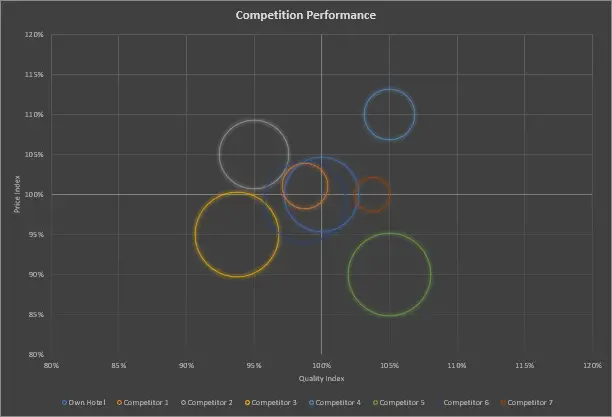
While that guide equipped you with a wider understanding of your competitive environment, it did not delve into the significance of the identified position and how you can use it to craft a sustainable long-term strategy. This is where our current guide steps in.
In this article, we build upon the insights from the previous guide and delve into the nuances of the price-quality matrix within the hotel industry context. This strategic tool, composed of nine quadrants, illustrates various strategic positions a hotel can choose based on varying levels of price and quality. Our goal is to assist you in interpreting this model and leveraging it for optimal long-term success. So, let’s begin.
An Overview of the Price-Quality Quadrants
To effectively steer your hotel through the competitive terrain of the hotel industry, it’s beneficial to comprehend the quadrants of the Pricing-Quality Model. This matrix, initially introduced by the esteemed marketing strategist Philip Kotter, serves as a strategic tool that evaluates a business’s value proposition by positioning its offerings within a grid marked by varying levels of price and quality.
When applied to the unique aspects of the hotel industry, we can map out nine distinct quadrants. Each quadrant represents a unique mix of price and quality, with your choice of quadrant significantly influencing your hotel’s strategic positioning.

The essential understanding here is that each quadrant comes with its own set of challenges and potential rewards. For instance, the ‘Premium’ quadrant (high price, high quality) requires an ongoing commitment to unparalleled quality, whereas the ‘Economy’ quadrant (low price, low quality) necessitates a focus on pricing strategy and volume sales.
Even the ‘Market-Rate’ quadrant (medium price, medium quality), situated in the matrix’s centre, has its own hurdles due to its non-distinctive positioning that lacks a clear competitive advantage.
The ‘High Value’ and ‘Good Value’ quadrants present opportunities to deliver services of a higher calibre than competitors, while still maintaining competitive pricing. These zones are often considered the sweet spots where guest satisfaction converges with profitability, making them attractive targets for many hoteliers.
Recognising the pros and cons of each quadrant, including the risks and opportunities they present, is crucial to making informed decisions about your hotel’s strategic positioning. This all-encompassing perspective enables us to accurately assess your hotel’s current state and begin formulating a successful strategy.
Having outlined the broader framework, let’s explore the characteristics of the several zones within this matrix.
Pinpointing Risk Zones in the Pricing-Quality Model
As we traverse the complexities of Kotter’s Pricing-Quality Model, we must highlight potential risk zones that could severely hamper a hotel’s sustainability and growth. These areas include:
‘Rip-Off’ Zone: The most risky and first zone. Characterised by high prices and low quality, this quadrant poses the risk of damaging a hotel’s reputation. Guests may perceive the high cost as unwarranted given the service quality, leading to dissatisfaction and potential reputation harm.
‘False Economy’ Zone: This zone, marked by medium prices and low quality, might initially draw budget-conscious guests. However, the perceived lower value for the price may eventually steer these guests towards competitors, instigating a cycle of low guest retention and declining revenues.
‘Market Rate’ Zone: The last zone, occupying the medium price, medium quality quadrant, is characterized due to its lack of a unique selling proposition or distinctive positioning. Therefore it is often not recognized as a risk zone. Hotels in this position may find themselves losing guests to competitors who offer better service for the same price (High Value) or similar service at a lower price (Good Value).
Aiming for Favourable Positions in the Pricing-Quality Model
While identifying and avoiding these risk zones is vital, we also need to shed light on the more favourable positions to aim for:
‘Premium’ Zone: Marked by high prices and high quality, this quadrant demands the consistent delivery of superior services to justify the premium price. It caters to guests who appreciate luxury experiences and are prepared to pay for them.
‘Economy’ Zone: This zone targets the most price-sensitive segment of the market with low prices and low quality. Success in this quadrant hinges on high-volume sales and strict cost management to offset the lower price point.
‘High Value’ and ‘Good Value’ Zones: These areas offer the best balance between price and quality. The High Value quadrant represents a situation where you deliver high-quality services at a medium price, while the Good Value quadrant involves offering medium quality at a low price or high quality at a low price. Both quadrants can lead to high guest satisfaction and positive word-of-mouth, which are vital for sustainable success.
While the ‘Premium’ and ‘Economy’ quadrants have clear-cut strategies, the real opportunity lies within the ‘High Value’ and ‘Good Value’ quadrants. Here, hotels can outperform competitors by providing superior quality services while ensuring competitive pricing. This positioning can significantly boost guest loyalty and potentially increase revenue.
Comprehending the ‘Superb Value’ Zone in the Pricing-Quality Model
Lastly, it’s worth discussing the ‘Superb Value’ Zone. While it may seem attractive to guests due to its high-quality, low-price proposition, this zone can strain a hotel’s profit margins and lead to lower returns on investment. Despite its potential to enhance short-term guest satisfaction, this strategy might not be sustainable in the long run. Striking a balance between guest expectations and maintaining profitable operations is crucial for a hotel’s enduring success.
Understanding the Pricing-Quality Model and your position within it is only part of the journey. The next step involves formulating and executing strategies to move your hotel into the most favorable quadrant for your market and customer base. This involves careful planning, constant monitoring, and timely adjustments – all areas where MinersRepublic can provide expert support.
Are you ready to explore the possibilities and plot your course on the Pricing-Quality Model? Contact MinersRepublictoday. Let us guide your journey towards sustainable success in the hotel industry.
Crafting Your Hotel’s Long-Term Strategy with MinersRepublic
With a comprehensive understanding of the Pricing-Quality Model, hotel owners and revenue managers are well-equipped to formulate a strategic plan that balances guest satisfaction, profitability, and long-term growth. Recognizing your hotel’s current and desired positions within this matrix is a critical first step in establishing a firm foundation for your strategic plan.
This process necessitates a custom approach, taking into account the unique characteristics of your property, the demands of your guest base, and the specific conditions of your market. Expert guidance, like that offered by MinersRepublic, can be invaluable here. Their expertise supports hoteliers in crafting an effective, sustainable strategy based on a comprehensive understanding of positioning within the Pricing-Quality Model.
With a clear strategy in place, hoteliers can then fine-tune tactics throughout the year. This continuous optimization of prices, content, and promotions not only increases guest loyalty but also sets the stage for higher profitability and sustainable growth for your hotel.
Understanding your position within the Kotter’s Pricing-Quality Model is just the start. The subsequent critical step involves creating and executing strategies that propel your hotel into the most favourable quadrant for your market and guest base. This requires meticulous planning, continuous monitoring, and timely adjustments – all tasks where the expertise of MinersRepublic can be particularly beneficial.
Ready to explore the possibilities and plot your course within the Pricing-Quality Model? Reach out to MinersRepublic today.